
Last updated: 5 October 2026
RESTRUCTURING AND REDUNDANCIES: EMPLOYERS’ OBLIGATIONS, EMPLOYEES’ RIGHTS AND SUPPORT FOR CAREER TRANSITION
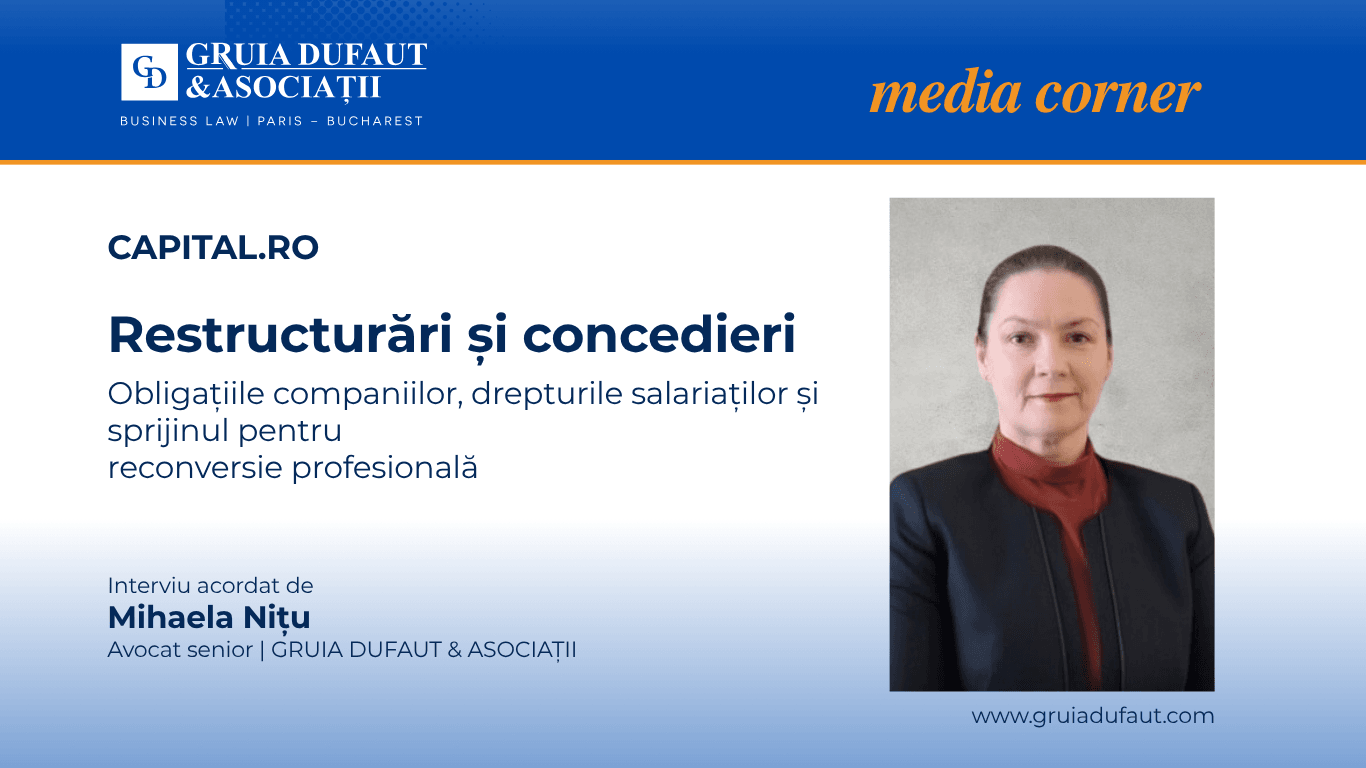
What does legally compliant restructuring involve, and how can employees prepare for a professional transition? In an interview with Capital.ro, Mihaela NIȚU, Senior Associate at Gruia Dufaut & Asociații, explains the main risks associated with individual and collective layoff procedures, the differences between layoff and termination of the employment relationship by mutual agreement, and the role of the European Globalisation Adjustment Fund (EGF) in supporting professional retraining, reskilling and the search for a new job.
Capital.ro: What is your view on the Romanian labor market from the perspective of redundancies? Do you notice a growth in the number of companies preparing staff cut-offs or collective layoffs?
Mihaela Nitu: There is a growing number of reorganizations resulting in staff layoffs, materialising in cut-off of vacancies, individual or collective redundancies. Companies pay extensive attention to budgets, all costs are under careful scrutiny, including headcount. The logic is to cut costs wherever is possible.
Capital.ro: Which are the fields more likely to see restructurings and layoffs?
Mihaela Nitu: The most affected lines of business remain: automotive, IT, retail, constructions, amidst declining consumption, driven by rising inflation, fuel and energy prices, and regional and global security issues.
Capital.ro: Automation and artificial intelligence, do they become real grounds for cutting-off certain roles? What must the employer demonstrate?
Mihaela Nitu: From a legal perspective, artificial intelligence in itself cannot constitute grounds for layoffs. However, insofar as an analysis at the level of the company shows that introducing new technologies may boost performance, reduce costs, then automation and artificial intelligence can account for just and serious cause for reorganization and for employee layoff, respectively. Thus, can be met the conditions provided by the Labor Code for layoff for cause non-attributable to the employee.
Capital.ro: How important is it to apply for EGF prior to layoffs?
Mihaela Nitu: It surely is beneficial for the concerned employees, since it gives the employer access to European funds enabling them to provide support to staff facing redundancy, such as professional retraining or reskilling. Such funds give the employees the chance to get new skills to be used in the same field, but with higher qualification or to make a shift towards another field where there is a greater need of staff. Therefore, we can presume that EGF funds help employees to find another job in less time. It a measure with medium and long term effects.
Capital.ro: How realistic is that the mechanism be actually used in Romania?
Mihaela Nitu: The scenario is realistic, but not it’s not happening automatically. Romania, and by Romania, I mean the employer (the company) and the competent authority (Labor Ministry), must draw up the project rapidly and apply to the European Commission.
In other words, just like the other EU countries having used this mechanism, Romania must want to benefit from it. The company, the authorities, the Labor Ministry – The National Agency for Employment (ANOFM), the union or the employees’ representatives must work together to get the funds from the EU.
The main risk is not related to eligibility but to deadlines. Information continues to reach us late, while responsibilities and signals from the authorities are unclear, which means missing the window of opportunity when such measures might prevent unemployment. And I will give you a concrete example: I myself have asked information about EGF from the authority. Don’t assume I received any answer so far.
Capital.ro: A company announces 300 persons redundancy. Which are the first steps?
Mihaela Nitu: According with the Regulation, the company must initiate the procedure of information and consultation with the employee’s representatives (union or elected representatives), in line with the provisions of the Labor Code. In parallel, the Romanian employment authorities must be contacted and prepare the EGF application.
Prior to preparing the application, must be identified the concerned persons, their skills and the applicable measures: training, counselling, certification, mobility or entrepreneurial support.
The list of redundancies identifies the affected staff and the skills appraisal points to the solution that might work.
Capital.ro: Can the employees determine accessing the EGF if the employer does not take the initiative?
Mihaela Nitu: The employees may not apply for EGF directly to the Romanian authority or the European Commission. Only the member State may apply for the funding to the European Commission.
However, they can refer the matter to the union or the employees’ representatives who can ask for EGF to be accessed within the consultations taking place in the collective lay-off procedure.
Capital.ro: How long could it take for the support to benefit the employees?
Mihaela Nitu: This is not an on-the-spot mechanism. Romania must prepare the application, which is further assessed by the Commission and approved via the European budgetary procedure. This can take several months.
Which is why early intervention must be taken literally: the project must be prepared at the time of notification of the redundancy.
Certain eligible measures may be initiated before the final funding decision is made, but the State must assume the risk if the application is not granted.
Capital.ro: Can an employee benefit of training while still being employed?
Mihaela Nitu: Yes. This is the very point of preventive intervention: the employee at risk may take classes, receive professional counselling and benefit from support in finding another job prior to layoff.
Nevertheless, distinction should be made between the obligations of the employer and EGF measures. The Regulation specifically provides that the Fund cannot be used to transfer to the European budget costs falling to the company under the law or the collective agreement.
Capital.ro: What happens if the company decides to no longer pursue the layoff of the employee?
Mihaela Nitu: In my view, the continuation of the support is not an unlimited right. EGF funds a real professional transition not a general training unrelated to the redundancy. Where the funds were used for reskilling and following such reskilling the concerned employee is no longer laid off but allocated to a new role supported by such reskilling, the EGF funds have been put to good use.
Capital.ro: How important is it to include the employees of downstream suppliers and producers?
Mihaela Nitu: Including employees from these categories of employers in the scheme is highly welcome. For instance, in the automotive, electronics, or other industrial manufacturing sectors, a large employer supports a network of local suppliers. A drop in orders can trigger a chain reaction of layoffs at smaller suppliers, companies that otherwise would not be able to access financial support for workforce reskilling or assistance in finding new jobs for the affected employees.
Capital.ro: Can an eligible application not be funded where the European funds have exhausted?
Mihaela Nitu: Yes, from a legal and budgetary point of view this risk exists. There is not an amount reserved neither for Romania, nor for other EU country. EGF works as an European special instrument, limited to the budget annually available.
For 2026–2027, the Commission indicates an annual budget of EUR 35 million and a 60%–85% co-funding.
Capital.ro: Is there interest from Romanian companies in this mechanism?
Mihaela Nitu: That, we shall see at the end of the funding period. There have been companies having accessed this fund in the previous years, but that was prior to the review of the European legislation in in its current form.
Capital.ro: Which are the mistakes that companies make most often?
Mihaela Nitu: Strictly with respect to collective layoffs, I would say that, sometimes, the economic decision is made without being supported by thorough analysis of the legal procedure. In other cases, the internal consultation with the social dialogue partners is skipped or is poorly documented.
I would also like to mention the failure to observe the legal deadlines (for consultation, notification of the authorities, notices etc.) during the process or the use of rather unclear selection criteria.
Another error often seen in practice, which is not necessarily subject to legal sanction, is poor communication. Legally aligned restructuring brutally managed remains a poorly handled restructuring.
Capital.ro: When can a layoff be successfully challenged?
Mihaela Nitu: A layoff can be successfully challenged when the role has not been actually cut-off or the cause for the cut-off is not true and serious or when the reorganization hides discrimination, retaliation or performance assessment.
Last but not least, inobservance of the procedures, obligations and deadlines involved result in nullity of the layoff irrespective of whether the employer has solid grounds.
For instance, miscalculation of the 20-working day notice can entail nullity of the layoff, even if it’s one day (e.g. including in the 20-day notice the day of service of the notice).
Considering that, in case of litigation, the employer is bound to provide evidence, the company must document the layoff in the reorganization decision, the economic or technologic motives and the criteria applied, pre and post layoff organization charts.
However, it should be noted that the court checks the grounds and the lawfulness of the layoff and not its economic opportunity.
Capital.ro: Are dismissal and parties’ agreement suggested when staff cut-off is intended?
Mihaela Nitu: The Labor Code provides for the cases of termination of the employment relationship: initiated by the employer – the layoff, initiated by the employee – the resignation and the parties’ agreement.
Resignation is a unilateral act of will by which the employee decides to terminate his/her employment agreement. Therefore, an employer could never suggest an employee to resign. To the contrary, this may be seen as a form of pressure.
The termination of the employment relationship by mutual agreement may be initiated by either party, therefore, including the employer.
Thus, an agreement between the parties is indeed possible, even after the employer has initiated a collective or individual layoff process. However, it is essential that the employee be fully aware of and understand the consequences, as their rights vary depending on the cause of the contract's termination, particularly regarding eligibility for unemployment benefits.
Capital.ro: What can the employee lose when accepting termination by the parties’ agreement?
Mihaela Nitu: The employee can lose the legal notice of minimum 20 working days, potential severance pay related exclusively to layoff (which is usually replaced by a termination compensation in an amount at least equal). However, in this case, priority for rehire, specific to collective layoffs, and access to unemployment benefits (granted for between 6 and 12 months), conditional upon the layoff be non-attributable to the employee, are lost.
The agreement is worth signing only if the terms of termination are correct or if the exit pay is negotiated in a satisfactory manner.
Capital.ro: When is severance pay mandatory?
Mihaela Nitu: The Labor Code does not guarantee automatically severance pay for any redundancy, be it individual or collective. Nevertheless, the employee is mandatorily owed the compensation provided for under the applicable collective agreement or other internal policies of the company or, as appropriate, under a specific clause in the employment contract. Unless such grounds exist, the compensation may be negotiated, but it is not automatically owed by the employer.
Capital.ro: Which documents must be checked? Which are the documents one should avoid signing on the spot?
Mihaela Nitu: The individual employment contract and any addenda, the collective bargaining agreement, internal regulations, compensation policies, the notice of termination, the termination agreement, the layoff decision, and any settlement agreement regarding the waiver of claims.
As with banking or other situations, no document should be signed without fully understanding its implications. However, signing to acknowledge receipt of a document must not be confused with accepting its content.
Thus, signing to acknowledge receipt of a notice of termination or a layoff decision does not mean the employee agrees with the document's content, it only confirms receipt thereof.
Capital.ro: Which the employee’s biggest mistake?
Mihaela Nitu: Reacting before fully understanding the documents. Resigning under pressure or in a fit of anger, sending aggressive messages, copying large volumes of company files, or posting about the situation on social media can create additional problems. The first step is not conflict, but rather understanding the situation and legally preserving information: your own documents, the timeline of discussions, and written requests.
Capital.ro: Which are the rights least known by the employees?
Mihaela Nitu: The right to at least 20-working day notice, the fact that the employee has no obligation to take leave during the notice, the right to information and consultation, in collective layoffs, 45-day priority right to being re-hired if the same activity (requiring the same skills) is resumed after a collective layoff, or the fact that upon termination of the employment contract the employee is entitled to compensation for the outstanding days of annual leave. Also, it less known that it is the employer who must provide evidence. The employee must file the challenge within the deadline. The company must prove that the measure is lawful.
Capital.ro: Three recommendations for employees facing a position cut-off?
Mihaela Nitu: No. 1: read thoughtfully the documents served.
No. 2: check what you lose and what you get in each scenario: layoff, parties’ agreement. Compare in terms of money, time and rights.
No. 3: start the transition right away. In addition to the severance pay, which ensures immediate, but limited support, ask for support in training, counselling, finding a new job, especially in roles or fields where there is a shortage in job opportunities, access to EGF (where the conditions are met).
The best protection is not to wait for the last day but to prepare for the future.
Read the interview below, published in Romanian by Capital.ro.
- Exclusiv. Restructurările se înmulțesc în România. Domeniile cu cel mai mare risc și când poate AI să ducă la concedieri
- Exclusiv. Sprijin pentru angajați înainte să fie concediați. Cum pot fi folosite fondurile europene pentru reconversie profesională
- Exclusiv. Ce poate pierde un angajat dacă semnează acordul părților. Drepturile la care poate renunța fără să știe